 Ideas Factory/ the foundry
← the floorAlba/parts·if / 067
How to build it
The same ply, epoxy and glass method as Notte Blu, with a separate superstructure: 21 steps, 8,000 to 12,000 hours, and about £170,000 to £335,000.
The card
parts 05 of 06How to build it
parts 05 of 06idea_067
The notes
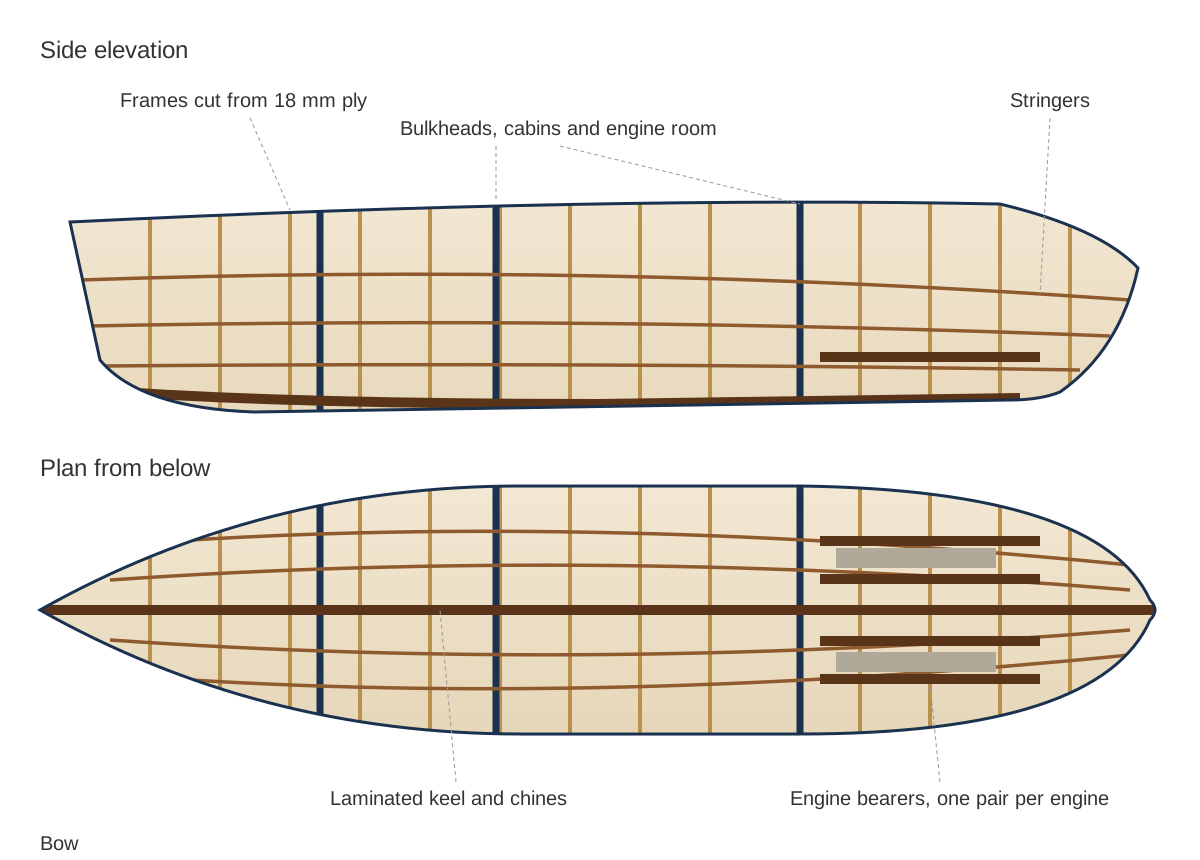
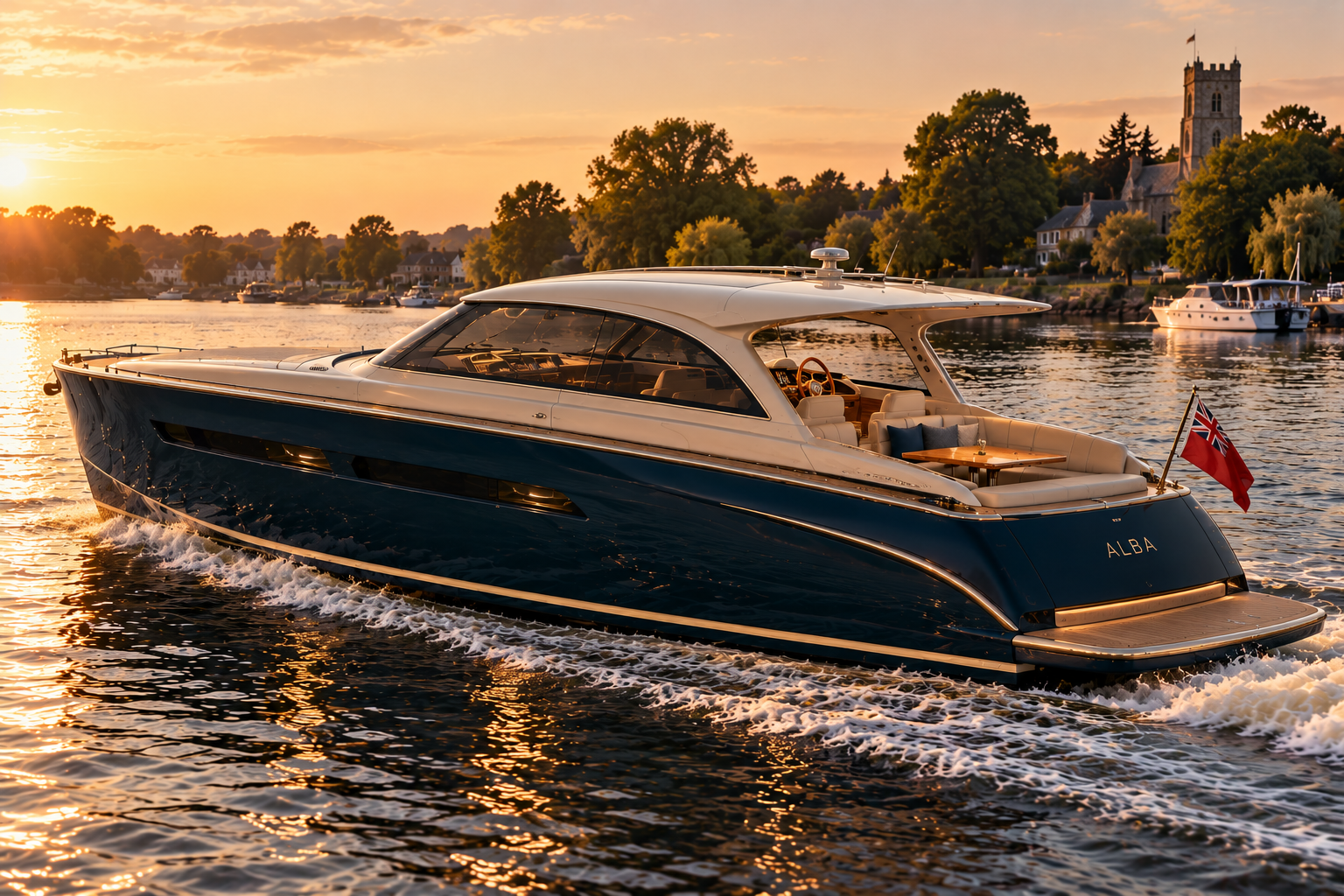
renderedSame method as Notte Blu: plywood frames on a strongback, timber stringers, marine ply skins in epoxy, glass sheathed. The superstructure is built as a separate ply and epoxy structure on the finished deck. Alba is larger and has far more interior, so expect roughly 8,000 to 12,000 hours for one person, about 5 to 7 years part time. All hours and costs are approximate.
before you start
- Commission a naval architect for full plans, scantlings and stability. A sea-going cruiser carries more weight high up than a speedboat, so stability checks matter more. Budget £8,000 to £18,000.
- Same UK rule as Notte Blu: the Recreational Craft Regulations exempt boats built by their future user, provided you don't sell within 5 years.
- Workshop of at least 16 m x 7 m with 5 m headroom, heated to 15 °C or more.
step by step
- Plans and lofting (about 200 h). Final plans, full-size frame drawings or CNC-cut frame kits.
- Strongback (about 80 h). Level, rigid base the full length.
- Frames, stem and tail formers (about 400 h). Cut frames from 18 mm ply, laminate the stem and sculpted tail formers, set up upside down.
- Keel, chines, stringers, engine bearers (about 500 h). Glue and fasten with thickened epoxy.
- Fair the framework (about 250 h).
- Bottom planking (about 450 h). Two layers of 12 mm ply.
- Topside planking (about 350 h). 9 to 12 mm ply, forming the crease.
- Glass sheathing (about 300 h).
- Fair and prime (about 500 h).
- Roll the hull (about 30 h, plus helpers and lifting gear).
- Bulkheads, floors and tank bays (about 600 h). Two levels: lower deck floor and saloon floor.
- Coat the inside (about 200 h).
- Tanks, engines, running gear, hybrid units (about 600 h).
- Deck beams and deck (about 500 h).
- Superstructure and hardtop (about 900 h). Saloon sides, curved roof on laminated beams, hardtop and pillars, window openings.
- Glazing (about 150 h). Saloon windows and hull slots, bonded in.
- Systems (about 1,200 h). Wiring, batteries, hybrid controls, steering, fuel, two bathrooms, galley, heating, ventilation, bow thruster.
- Paint (about 450 h). Ideally sprayed professionally.
- Interior fit-out (about 1,800 h). Two bedrooms, two bathrooms, saloon, galley, pale oak and upholstered panels.
- Deck fit-out (about 300 h). Helm, seating, platform, cleats, lights.
- Launch, sea trials, survey (about 80 h).
materials and rough costs
| Item | Quantity (approx.) | Cost (approx., inc VAT) |
|---|---|---|
| Naval architect plans | 1 set | £8,000 to £18,000 |
| Marine ply, BS1088 | about 120 sheets | £8,000 to £14,000 |
| Timber for keel, stringers, frames | Douglas fir or larch | £5,000 to £8,000 |
| Epoxy resin and hardener | about 500 kg | £7,500 to £9,000 |
| Glass cloth and fairing compounds | about 150 m² cloth | £3,000 to £4,500 |
| Paint system | primer, topcoat, antifoul | £5,000 to £9,000 |
| Twin D4-300 with V-drives | 2 | about £70,000 to £100,000 |
| Shafts, props, rudders, steering, bow thruster | 1 set | £15,000 to £22,000 |
| Tanks, plumbing, electrics, electronics | 1 set | £20,000 to £30,000 |
| Interior: 2 bedrooms, 2 bathrooms, galley, saloon | 1 set | £20,000 to £35,000 |
| Deck hardware, hardtop, glazing, platform | 1 set | £10,000 to £16,000 |
| Total, twin diesel | about £170,000 to £265,000 | |
| Hybrid system (extra) | 2 motors, batteries, controls | about £40,000 to £70,000 |
| Total, hybrid | about £210,000 to £335,000 |
Engine and hybrid prices are not published, so those figures are rough estimates; get supplier quotes. Ply and epoxy are scaled from the prices used for Notte Blu.
The drawings
2 sheets