 Ideas Factory/ the foundry
← the floorNotte Blu/parts·if / 066
How to build it
Frame and stringer construction in marine ply, glass and epoxy: 19 steps, 5,000 to 8,000 hours, and about £160,000 to £245,000.
The card
parts 06 of 07How to build it
The notes
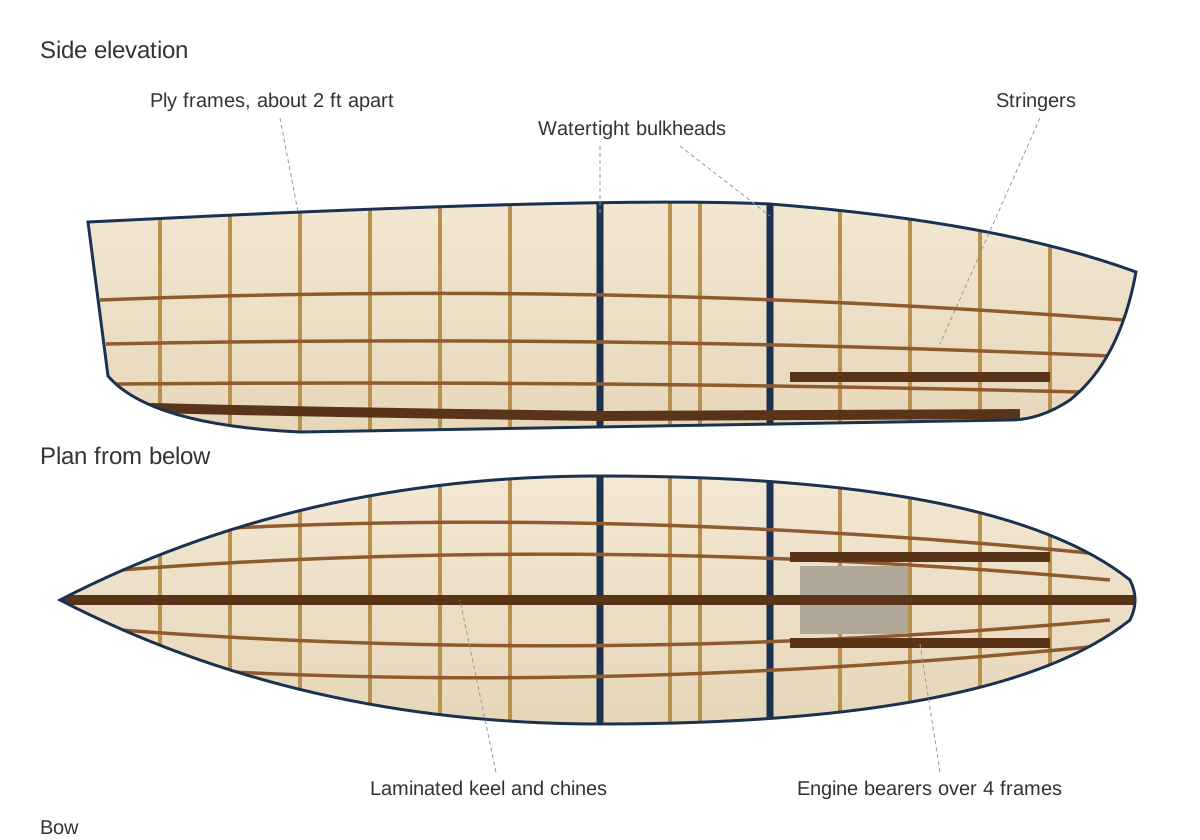
renderedMethod: frame and stringer construction. Plywood frames sit on a strongback, longitudinal timber stringers run between them, and marine ply skins go over the top. The bottom gets two layers of ply, and the whole hull is sheathed in glass cloth and epoxy. This is the proven way to build a fast, stiff ply hull with complex shapes like the sculpted tail.
Expect roughly 5,000 to 8,000 hours for one person, so 3 to 5 years of evenings and weekends. All hours and costs below are approximate.
before you start: the non-negotiables
- A 40+ knot deep-V hull carries big slamming loads. Commission a naval architect to turn this concept into full plans with scantlings (frame spacing, ply thicknesses, stringer sizes), engine bearers and stability checks. Budget £5,000 to £15,000.
- In the UK, the Recreational Craft Regulations exempt boats built by their future user for their own use, as long as you don't sell within 5 years of putting it into service. Selling sooner needs a post construction assessment.
- Insurance, a survey on completion and registration (Part 1 or the Small Ships Register) are still worth doing.
workshop
- Clear floor of at least 14 m x 6 m, with 4 m of headroom for rolling the hull
- Heated to 15 °C or more, since epoxy cures poorly in the cold
- Dust extraction, good ventilation and respirators for epoxy and sanding
step by step
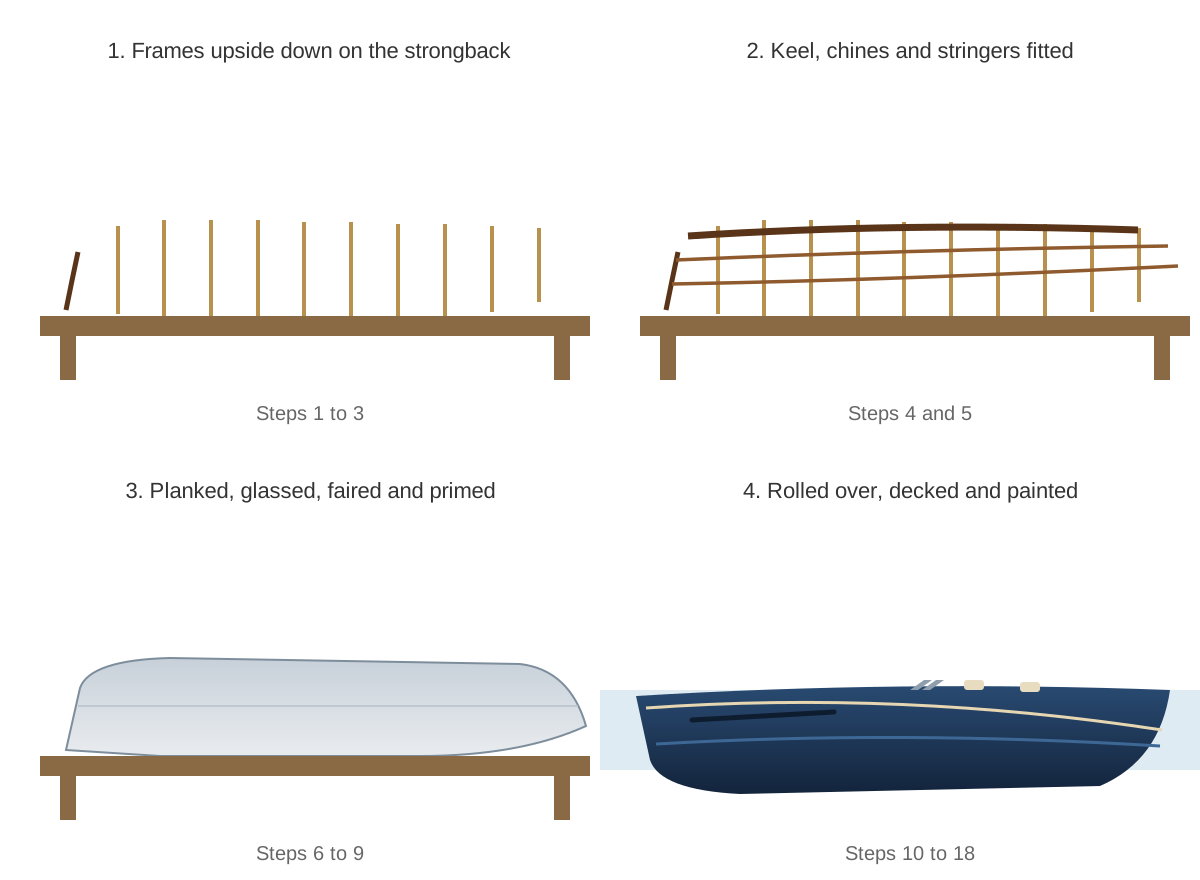
- Plans and lofting (about 150 h). Get the final plans, then draw frames full size on the floor or buy CNC-cut frame kits from the designer.
- Strongback (about 60 h). Build a dead-level, rigid timber base the length of the boat. Everything else is measured from it.
- Frames and transom-tail former (about 300 h). Cut frames from 18 mm ply, laminate the bow stem and the curved tail formers, and set them upside down on the strongback.
- Keel, chines and stringers (about 400 h). Fit the laminated keel, chine logs and longitudinal stringers. Add the engine bearers now, tied into several frames. Glue everything with thickened epoxy.
- Fairing the framework (about 200 h). Plane and sand every edge so the ply lies flat with no hard spots.
- Bottom planking (about 400 h). Two layers of 12 mm ply, the second laid at an angle and glued and screwed to the first.
- Topside planking (about 300 h). 9 mm ply on the sides. The sculpted crease is formed by a stringer and a faired joint.
- Glass sheathing (about 250 h). Biaxial glass cloth set in epoxy over the whole hull, heavier on the bottom.
- Fair and prime (about 400 h). Epoxy fairing compound, long-board sanding, epoxy primer. This step decides how good the paint looks.
- Roll the hull (about 20 h, plus helpers). Turn it right way up with a cradle, chain hoists or friends.
- Bulkheads and inner structure (about 400 h). Watertight bulkheads at the cabin and engine room, cabin sole with the sunken entrance, tank bays.
- Coat the inside (about 150 h). Epoxy every interior surface before closing anything in.
- Tanks, engines and running gear (about 400 h). Fit fuel and water tanks, lower in the engines, align shafts, fit stern glands, props and rudders. Get an engineer to check alignment.
- Deck beams and deck (about 500 h). Deck beams, ply deck, cockpit, hatch frames and skylights, then glass and epoxy over the deck.
- Systems (about 700 h). Wiring, batteries, steering, fuel lines, bilge pumps, fire suppression, plumbing for the galley and wet room, ventilation.
- Paint (about 300 h). Two-pack primer and topcoat, ideally sprayed by a professional for a gloss deep-ocean finish. Antifoul below the waterline.
- Interior fit-out (about 900 h). V-berth with drawers, galley, wet room, bench, locker, lining panels and upholstery.
- Deck fit-out (about 250 h). Deflectors, grab rails, sunpad, cleats, navigation lights, platform mechanism.
- Launch and sea trials (about 50 h). Check for leaks, run engines in, test at increasing speed, then a survey.
materials and rough costs
| Item | Quantity (approx.) | Cost (approx., inc VAT) |
|---|---|---|
| Naval architect plans | 1 set | £5,000 to £15,000 |
| Marine ply, BS1088 | about 75 sheets, 6 to 18 mm | £5,000 to £10,000 |
| Timber for keel, stringers, frames | Douglas fir or larch | £3,000 to £5,000 |
| Epoxy resin and hardener | 300 to 350 kg | £4,500 to £5,500 |
| Glass cloth and fairing compounds | about 100 m² cloth | £2,000 to £3,000 |
| Paint system | primer, topcoat, antifoul | £3,000 to £6,000 |
| Twin diesels with V-drives | 2 | about £100,000 to £140,000 |
| Shafts, props, rudders, steering | 1 set | £10,000 to £15,000 |
| Tanks, plumbing, electrics, electronics | 1 set | £12,000 to £20,000 |
| Interior, upholstery, galley, wet room | 1 set | £10,000 to £18,000 |
| Deck hardware, deflectors, platform | 1 set | £5,000 to £8,000 |
| Total | about £160,000 to £245,000 |
Engines are well over half the cost. Ply and epoxy prices are from current UK listings (12 mm BS1088 at £38.75 ex VAT, budget grade; West System 30 kg pack at £478.80). Engine prices are not published, so that figure is a rough estimate; get dealer quotes.
The drawings
2 sheets