 Ideas Factory/ the foundry
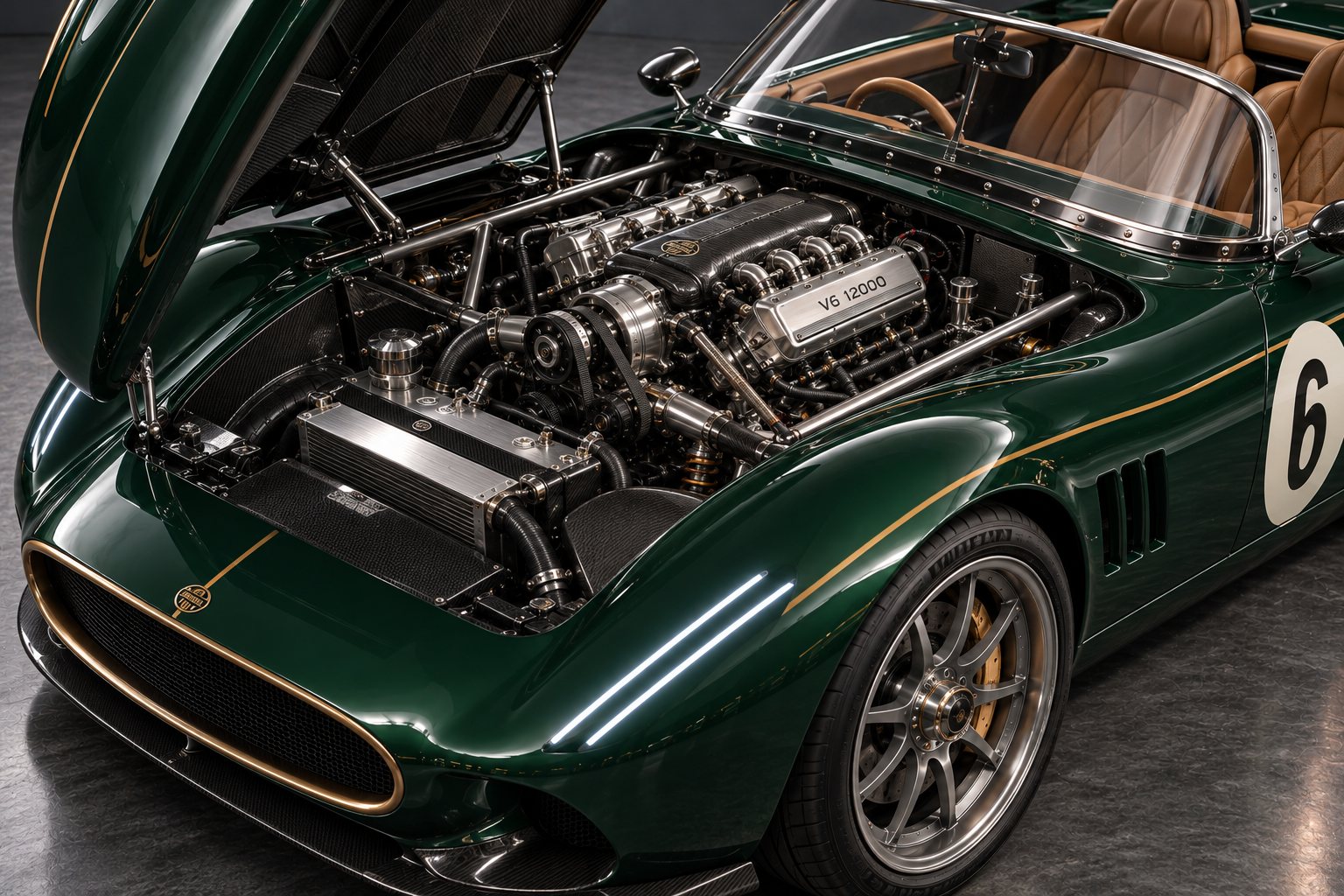
← the floorKreation Silhouette/parts·if / 070
Engine
Two Triumph 1160 cc triple top ends on a bespoke billet crankcase and six-throw crank, making a 2,320 cc 60° V6 with a centrifugal supercharger, for a target of 420 bhp at 10,750 rpm.
The card
parts 03 of 07Engine
The notes
renderedThe engine is the reason for the car: two high-revving motorcycle triples joined on a common crank as a 60° V6, with a supercharger.
specification
| Item | Specification |
|---|---|
| Layout | 60° V6, front-mid mounted, dry sump |
| Donor parts | Two Triumph 1160 cc triple top ends: heads, cylinders, pistons, rods, valvetrain |
| Bespoke parts | Billet crankcase, six-throw crankshaft, cam drive, sump, intake plenum |
| Capacity | 2,320 cc (2 × 1,160) |
| Bore × stroke | 90.0 × 60.8 mm |
| Compression | Around 11.0:1 (donor is 13.2:1, lowered for boost) |
| Induction | Belt-driven centrifugal supercharger, liquid chargecooler, plenum in the vee |
| Boost | Around 0.4 bar at peak, rising with rpm (est.) |
| Power | 420 bhp at 10,750 rpm (target) |
| Torque | 300 Nm at 9,000 rpm (est.) |
| Redline | 11,000 rpm |
| Engine weight | Around 120 kg dressed (est.) |
why centrifugal
Boost builds with revs, so the engine keeps its free-revving bike character and the top-end scream, while adding power where it is used. A twin-screw blower would fatten the midrange but blunt the rev-happy feel.
joining the engines
Two bike engines cannot simply be bolted together. Builders such as Hartley have done this before, with Hayabusa heads on a custom billet crankcase, and that is the model here. Budget for real development time.
Donor figures are from Triumph's published Speed Triple 1200 RS specification: 1,160 cc, 90.0 × 60.8 mm, 13.2:1, 180 PS at 10,750 rpm and 125 Nm.
The drawings
1 sheet
The plates
1 · lift any one out